
The California Board of Parole Hearings (BPH) issued a significant parole denial for convicted murderer, Alex Rubio.
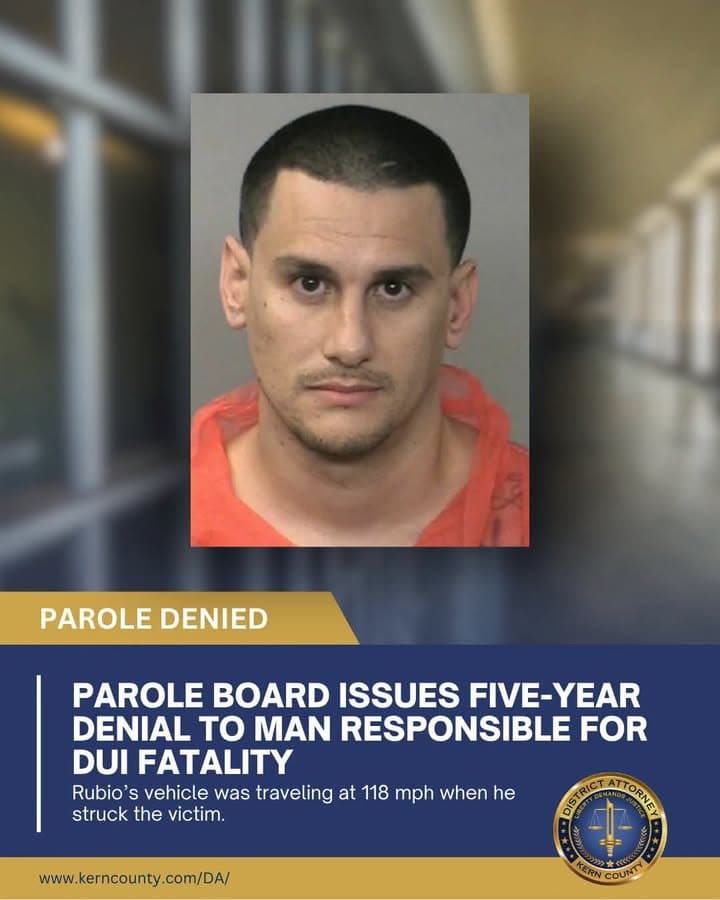
The California Board of Parole Hearings (BPH) issued a significant parole denial for convicted murderer, Alex Rubio. On July 15, 2026, BPH found that Rubio continues to pose a current and unreasonable risk to public safety. Representing the District Attorney’s Office and advocating for the denial was Deputy DA Gina Nargie.
On January 3, 2014, Rubio murdered Princess Almonidovar when he struck her car while traveling 118 mph near the intersection of Ming Avenue and New Stine Road in Bakersfield. Rubio’s vehicle struck the victim’s vehicle with so much force that Rubio’s vehicle went airborne, rolled over, struck a traffic signal pole and utility box, and slid on its roof before coming to its rest. Half of the roof of the victim’s vehicle was found approximately 600 feet away from her vehicle. The victim died at the scene.
Rubio was uninjured. Following the crash, Rubio fled the scene by jumping over a nearby wall and hiding in a backyard. When officers located him, Rubio led officers on a foot pursuit, chasing him over three six-foot fences before he was captured. After almost four hours after the crash, Rubio’s blood alcohol level was .14%.
On December 15, 2015, a Kern County Jury found Rubio guilty of murder in the second degree, gross vehicular manslaughter with an enhancement for fleeing the scene, driving while under the influence with enhancements for inflicting great bodily injury, failing to stop at the scene of an accident, and resisting arrest. He was sentenced to 15 years to life in state prison.
Rubio is currently 37 years old and has served approximately 10 years and six months in state prison. At the recent parole hearing, the commissioners focused on Rubio’s insight into his crime, history of substance abuse, programming, and institutional behavior. Ultimately, Rubio’s commissioners issued a five-year denial.
DA Zimmer commented; “A five-year denial is a significant and fair given the severity of the crime and the loss of a human life. Rubio’s preventable actions had an irreversible outcome, and meaningful accountability requires significant consequences.”